 Storeboard
Storeboard/Guides/English keywords by country
English isn't one market: keywords by country
"We support English" sounds like one decision. On the App Store it's four storefronts, four keyword fields, four sets of competitors — and most apps fill in exactly one of them.
Four storefronts wearing one language
App Store Connect offers English (US), English (UK), English (Australia) and English (Canada) as separate localizations. That's not cosmetic. Each maps to its own storefront, and each storefront carries its own:
- Keyword field — 100 characters, indexed independently.
- Name and subtitle — 30 + 30, also indexed independently.
- Search habits — genuinely different vocabulary and phrasing.
- Competitive rankings — who ranks for a term differs country to country.
Add it up: a US-only listing uses ~160 indexed characters. Filling all four English variants gives you ~640 characters of ranking surface for the same language — before you've translated a single word.
The vocabulary is really different
The famous examples are real search behaviour, not trivia:
| US searches | UK / AU searches |
|---|---|
| flashlight | torch |
| vacation planner | holiday planner |
| math practice | maths practice |
| soccer scores | football scores |
| resume builder | CV builder |
| check register | cheque book |
| gas mileage | petrol / fuel economy |
| favorites | favourites |
That last row matters more than it looks: spelling variants are separate queries. If your US field says
favorites, UK users typing favourites may not find you — and you'd never spend US
characters on the British spelling. A separate UK field means you don't have to choose.
Canada is the quiet hybrid: mostly US vocabulary, mostly UK spelling (colour, favourite), plus French Canada next door — which is its own localization again.
The competition differs even when the words don't
The second effect is less obvious and often bigger. Even for identical terms, the ranking table is per-storefront. A US-headquartered competitor who dominates "sleep tracker" at home may barely have bothered with Australia. Same term, different fight.
Smaller English storefronts are systematically less contested, for exactly the reason you're reading this: most developers stop at English (US). The apps that do fill in the AU field are competing against the minority who tried. This is the closest thing ASO has to an arbitrage — same copy, weaker opposition.
The strategy, in order
1. Duplicate first — ten minutes
Copy your US metadata into UK, AU and CA so the localizations exist and stop falling back. This is the floor, not the goal — a copied field ranks you for the same words against different competitors, which is already free upside.
2. Fix the vocabulary — half an hour
Sweep each field for US-isms and swap them: torch, holiday, maths, football, CV, favourites. Do the same sweep on the subtitle, which is indexed too. Your screenshots can stay shared at this stage — captions in neutral English travel fine.
3. Re-score per country — the real work
Run your tracked keywords against each storefront separately. The scores will surprise you: a term that's "crowded" in the US is often "worth it" in Australia. Where a US term is hopeless, replace it in that country's field with something winnable there. This is where the four fields stop being copies and start being four strategies.
4. Let the fields diverge — ongoing
Treat each country's field as its own small portfolio, reviewed at each release. UK gets the UK-winnable terms; AU chases what's open there. Nothing forces the four fields to agree, and past step 2 they shouldn't.
Some storefronts index a second language's localization. The classic: the US storefront also indexes Spanish (Mexico) — so filling in es-MX buys you ~160 more characters that still target US shoppers. The UK similarly cross-indexes. If a storefront matters to you, its bonus locale is free keyword space.
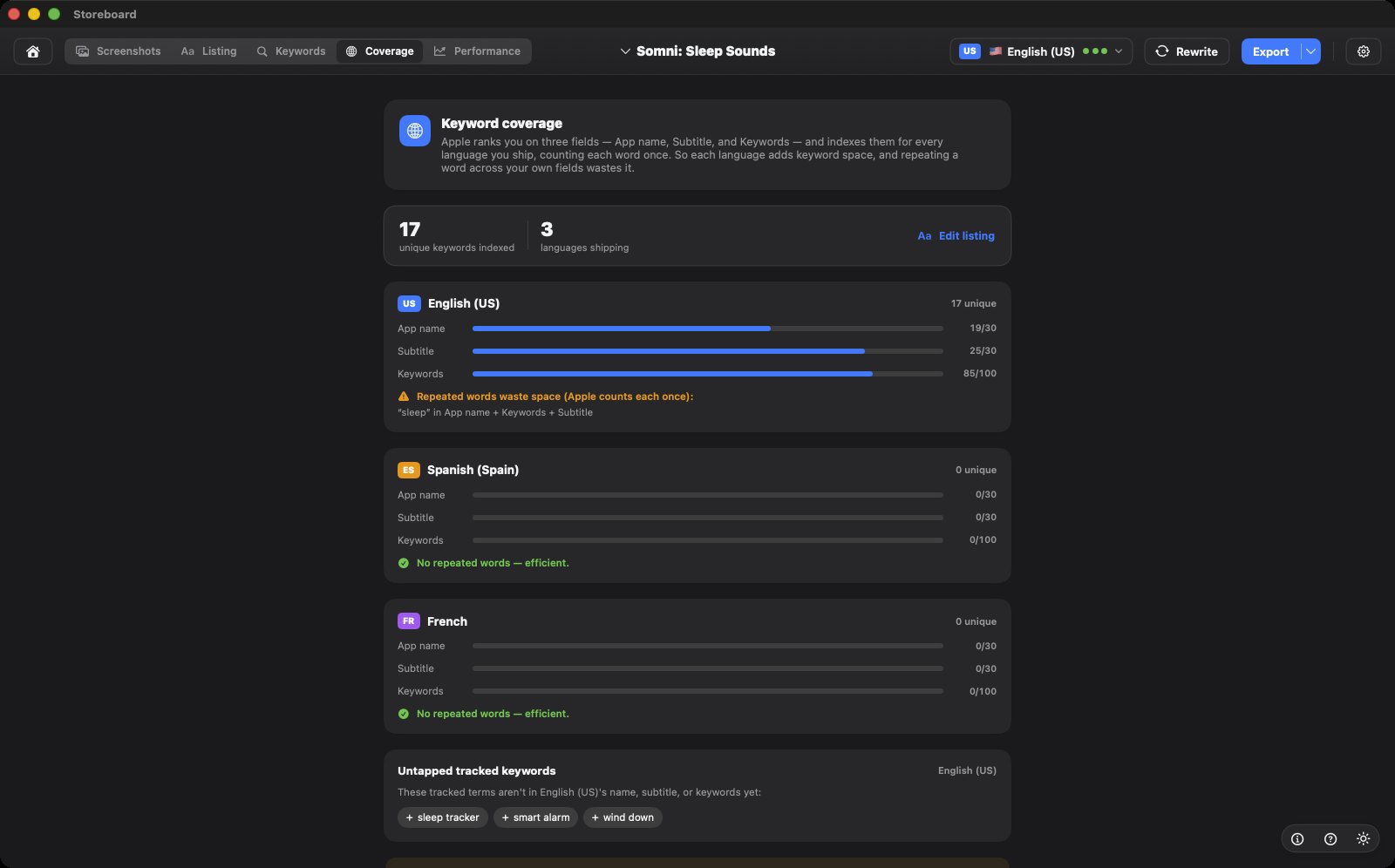
Research each country, not just each language
Storeboard scores your keywords per storefront — US, UK, Australia, Canada and 30+ more — and keeps an independent tracked set per English variant, compiled into each field automatically.
Download for MacWhat not to do
- Don't leave the variants empty — the fallback shows your US listing but re-uses its keyword field. You're forfeiting characters, not saving effort.
- Don't stop at copy-paste forever. Copies capture the different-competition effect but none of the vocabulary or divergence value.
- Don't localize the brand. Your app's name stays your name; it's the descriptive words around it that swap.
- Don't forget the subtitle. It's 30 indexed characters per country too — "Holiday budgets made simple" in the UK, "Vacation budgets made simple" in the US.
- Don't double-count words per field. The no-repeats rule applies within each localization: each country's name + subtitle + keywords should share no words. Check each one →
FAQ
Is this worth it for a small app?
It's especially worth it for a small app. Big-budget competitors saturate the US; the regional storefronts are where being the one who bothered still wins rankings. Steps 1–2 cost under an hour, total.
Do I need different screenshots per English variant?
Rarely at first. Keep captions in neutral English and share the sets. Once a market proves itself, localize spelling in captions ("favourites") as a polish pass — conversion, not ranking.
How different should the four keyword fields end up?
Expect 50–70% overlap — the core problem-words are shared — with the rest diverging: vocabulary swaps, plus terms that are winnable in one country and hopeless in another.
Does this apply to Spanish and French too?
Yes — Spanish (Spain) vs Spanish (Mexico) and French (France) vs French (Canada) follow exactly the same logic: separate storefronts, separate fields, different vocabulary, different competitors.